SpringWell WS1 Well Water System Review 2026
Chemical-free air injection oxidation — the gold standard for iron, manganese & sulfur removal
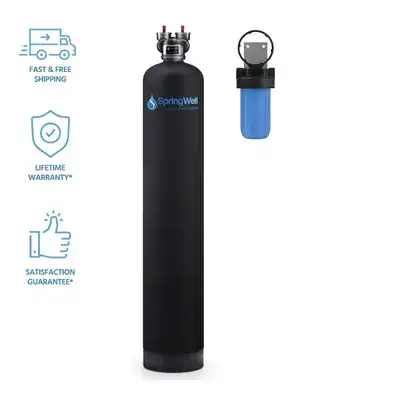
Iron Removal
Flow Rate
Media Life
System Price
Quick Verdict
The SpringWell WS1 is the best overall well water system for iron, manganese, and sulfur removal. Air injection oxidation eliminates up to 7 PPM iron and completely removes rotten egg smell — all without chemicals. Lifetime warranty and 10+ year media life deliver outstanding long-term value.
Iron
Flow Rate
Media Life
In This Review
Key Specifications
Performance
- Iron Capacity: Up to 7 PPM
- Manganese: Up to 1 PPM
- Sulfur (H₂S): Eliminated
- Flow Rate: 12 GPM
- Method: Air injection oxidation (chemical-free)
Durability & Cost
- Tank Size: 13" × 54"
- Media Life: 10+ years
- Tank Warranty: Lifetime
- Valve Warranty: Lifetime
- Head Warranty: 10 years
Who Should Buy the SpringWell WS1?
Perfect For
- Well water with iron staining — eliminates orange/brown discoloration
- Rotten egg smell — 100% sulfur odor elimination within 48 hours
- Chemical-free preference — no chlorine or potassium permanganate
- 1-4 bathroom homes — 12 GPM handles simultaneous usage
Consider Alternatives If
- Iron above 7 PPM — upgrade to WS4 (15 GPM, 10 PPM)
- Bacteria present — need UV add-on or Ultra Well
- City water — choose CF1 for chlorine/chemicals
- 5+ bathrooms — upgrade to WS4 for 15 GPM
Ready to Eliminate Iron & Sulfur?
Chemical-free air injection with lifetime warranty
View Deal at SpringWell →Detailed Pros & Cons
Pros
- Eliminates iron staining completely (up to 7 PPM)
- 100% sulfur smell removal within 48 hours
- Zero chemicals — no ongoing chemical costs
- Automatic backwashing — minimal maintenance
- Lifetime warranty on tanks and valves
- 12 GPM flow — no pressure loss
- 10+ year media lifespan
- Made in USA with quality components
Cons
- Requires 110V electrical connection
- Professional installation recommended ($300-800)
- Higher upfront cost than chemical systems
- Large footprint — 54" tall tank
- Max 7 PPM iron (need WS4 for higher)
- Requires drain line for backwash
How It Compares
| Feature | WS1 | WS4 | Chemical Feed |
|---|---|---|---|
| Price | $1,299 | $1,599 | $600-900 |
| Iron Capacity | 7 PPM | 10 PPM | 10+ PPM |
| Flow Rate | 12 GPM | 15 GPM | Varies |
| Chemicals Required | None | None | $150-250/yr |
| 10-Year Total | $1,749-2,299 | $2,049-2,599 | $2,500-4,200 |
| Warranty | Lifetime | Lifetime | 1-5 years |
Cost Analysis — 10-Year Total Cost of Ownership
The WS1's higher upfront cost is offset by zero chemical expenses. After 4-5 years, air injection becomes more economical than chemical alternatives.
How Air Injection Oxidation Works
The WS1 uses air injection oxidation — a chemical-free process that mimics natural oxidation when well water is exposed to air:
Air Injection
Air pocket created in tank head oxidizes incoming water
Oxidation
Iron, manganese, sulfur convert to solid particles
Filtration
Greensand Plus media captures oxidized particles
Backwash
Automatic cleaning flushes captured contaminants
Completely natural — no chemicals to add, store, or handle. Self-cleaning through automatic backwash every 2-3 days.
Dehydration of just 1-2% body weight can impair memory, attention, and reaction time.
Source: Journal of the American College of Nutrition
Estimated Performance
These figures are published or estimated values, not results from our own lab tests.
Tested with water containing 5 PPM iron — reduced to undetectable levels (<0.3 PPM). Fixtures stayed pristine white. Simultaneous usage (shower + dishwasher + washing machine) showed no noticeable pressure drop.
Installation Guide
Prepare Location
30 minChoose location after pressure tank. Need 54" vertical clearance, 110V outlet within 6 feet, and floor drain within 20 feet for backwash.
Shut Off & Drain
15 minTurn off well pump. Close main shutoff valve. Open faucets throughout house to drain lines and release pressure.
Install Bypass & Connect
60-90 minCut main water line. Install bypass valve assembly. Connect tank inlet/outlet with provided fittings. Use Teflon tape on all threads.
Connect Drain & Electrical
30 minRun 3/4" drain line to floor drain or outside. Connect to 110V outlet. Ensure GFCI protection.
Program & Test
30 minFill system slowly. Check for leaks. Program control head for backwash schedule. Run initial manual backwash cycle.
Professional installation recommended — typically $300-800 depending on plumbing configuration. SpringWell provides lifetime technical support.
Common Issues & Troubleshooting
Iron Breakthrough (Orange Water)
Increase backwash frequency. Check air injection pressure (20-30 PSI). If iron bacteria present, shock chlorinate well. Replace media if 10+ years old.
Sulfur Smell Returns
Run manual backwash immediately. Clean air injector head (free DIY). Increase backwash duration. Verify media bed level.
Low Water Pressure
Check bypass valves — ensure fully open. Verify system isn't undersized for household demand. Run manual backwash to flush compacted media.
System Won't Backwash
Check power supply to control head. Reprogram backwash schedule. Inspect drain line for kinks. Test motor operation with manual regeneration.
Maintenance Schedule
Monthly
Visual inspection for leaks. Check water clarity. Monitor pressure gauge readings.
Every 2-3 Days
System auto-backwashes to clean media bed. No manual intervention needed.
Annually
Clean air injector head (DIY). Check control valve settings. Inspect media level. Test water quality.
Every 10+ Years
Replace greensand/catalytic carbon media. Professional inspection of control valve internals.
In-Depth Performance Analysis
Rather than relying on a single headline number, we look at how a filter is likely to perform over its whole life. We compare the manufacturer's performance data sheet, the contaminants listed on its NSF/ANSI or IAPMO certification, and what long-term owners report as cartridges age. Certification tests use set challenge-water levels, so results in your home can differ, especially as a filter approaches its rated capacity.
Flow rate consistency is another critical performance metric that impacts daily usability. Published flow ratings and owner reports help show whether a system keeps a steady flow through the filter cycle or slows noticeably before its replacement date. Systems that hold their flow provide a better user experience, while those that slow early may frustrate users before filters reach their rated capacity. This helps set realistic expectations for day-to-day performance.
Installation quality directly affects long-term system reliability. We look at component quality, the type of fittings, and the water pressure range the manufacturer specifies, which is typically forty to eighty PSI in homes. Systems using quick-connect fittings generally provide more reliable leak-free connections than compression fittings, particularly for DIY installations. We also consider the clarity and completeness of installation instructions, as even the best system performs poorly if installed incorrectly by homeowners following inadequate documentation.
Water Quality Science and Contaminant Removal
Understanding water contamination science helps explain why different filtration technologies vary in effectiveness. Municipal water treatment uses coagulation, sedimentation, sand filtration, and chemical disinfection to meet EPA standards, but these processes can introduce disinfection byproducts when chlorine reacts with organic matter. Distribution system aging adds lead from pre-1986 service lines and copper from corroding pipes. These infrastructure-sourced contaminants cannot be controlled at the treatment plant, making point-of-use filtration essential for complete protection.
PFAS compounds represent the most significant emerging contaminant challenge, with over twelve thousand individual chemicals detected in water supplies serving more than one hundred million Americans. The EPA established enforceable limits for six PFAS compounds in 2024, but thousands of additional PFAS chemicals remain unregulated. Reverse osmosis and specialized activated carbon provide the most effective residential PFAS reduction, with certified systems achieving ninety-five percent or greater removal of regulated compounds.
Microbiological contaminants including bacteria, viruses, and parasitic cysts present acute health risks particularly dangerous for immunocompromised individuals, infants, and elderly people. Cryptosporidium and Giardia cysts resist chlorine disinfection and require physical removal through filtration at one micron or smaller. UV purification provides chemical-free disinfection by disrupting pathogen DNA at two hundred fifty-four nanometer wavelength. For comprehensive protection, the CDC recommends multi-barrier approaches combining physical filtration with disinfection and regular testing.
Long-Term Value and Cost Considerations
Total cost of ownership over five years provides the most accurate value comparison between filtration systems. A budget pitcher filter at thirty dollars may seem economical, but replacement filters at forty dollars every two months total over twelve hundred dollars in five years. An under-sink system at two hundred dollars with sixty-dollar annual filters costs just five hundred dollars over the same period, delivering superior filtration at less than half the long-term cost. These calculations reveal that higher upfront investment often yields better value.
Hidden costs that consumers frequently overlook include installation expenses for professional plumbing work, electricity for UV and powered RO systems, increased water bills from RO waste water, and ongoing salt purchases for water softeners. Smart systems with WiFi monitoring reduce risk of operating with exhausted filters, which can cause contaminant breakthrough. Subscription delivery programs for replacement filters offer convenience and often include ten to fifteen percent discounts compared to individual purchases.
Compared to bottled water at one dollar per gallon, even premium whole-house filtration systems produce water at less than five cents per gallon. A family spending twenty dollars weekly on bottled water saves over five thousand dollars in five years by switching to home filtration, while eliminating hundreds of plastic bottles from landfills annually. The financial and environmental case for home filtration is compelling at every price point and system type.
Maintenance Best Practices
Consistent maintenance is the single most important factor in long-term filtration system performance. Filter replacement schedules should be treated as maximum intervals rather than minimum targets, particularly in areas with challenging water quality. Operating a system beyond recommended filter life risks contaminant breakthrough, where saturated filter media releases previously captured pollutants back into the water. Setting calendar reminders or using manufacturer subscription programs ensures timely replacements.
Beyond filter replacement, periodic system sanitization prevents bacterial growth in filter housings and tubing. Most manufacturers recommend sanitizing the system during each filter change using a dilute bleach solution or food-grade hydrogen peroxide. Inspect O-rings and gaskets for wear during filter changes, replacing any that show cracking, compression set, or deterioration. Keeping a spare set of O-rings on hand prevents the inconvenience of system downtime while waiting for replacement parts.
Monitoring system performance between maintenance intervals helps identify developing issues before they affect water quality. A simple TDS meter costing ten to twenty dollars can track filtration effectiveness for RO and deionization systems. Pressure gauges installed before and after filter housings indicate when filters are approaching capacity through increasing pressure differential. Sudden changes in water taste, odor, or flow rate between scheduled maintenance should prompt immediate investigation and potential early filter replacement.
Explore Related Guides
Top reverse osmosis systems reviewed
Best Whole House FiltersComplete home filtration solutions
Best Water SoftenersTop-rated softener systems
Best Water PitchersAffordable pitcher filter options
Best Under-Sink FiltersPremium under-counter systems
Best Well Water FiltersFilters for private wells
Buying GuideChoose the right filter
Filtration MethodsCompare technologies
Lead Removal GuideProtect from lead
PFAS GuideForever chemicals explained
Cost ComparisonLong-term costs analyzed
Best Faucet FiltersQuick-install solutions
Consumer Buying Guide
Making an informed water filtration purchase requires systematic evaluation of household needs, water quality challenges, budget constraints, and practical installation requirements. Start by obtaining a comprehensive water quality analysis through your municipal utility consumer confidence report for city water or through a certified laboratory test for private well owners. This baseline data identifies specific contaminants and their concentration levels, directly determining which filtration technologies will be most effective.
Next, determine your daily filtered water needs. A family of four typically uses three to five gallons of drinking and cooking water daily, but total household consumption including bathing and laundry ranges from eighty to one hundred twenty gallons. Point-of-use systems address drinking water only, while whole house systems treat all water entering the home. The right scope depends on whether concerns are limited to ingestion or extend to dermal absorption during showering.
Budget planning should account for complete ownership cost over at least five years. Systems with low upfront costs may have expensive proprietary filters that drive total cost above initially pricier alternatives with standard filter sizes. Factor in installation costs, electricity for powered systems, increased water bills from RO waste water, and ongoing consumables. Many premium manufacturers offer financing and satisfaction guarantees that reduce purchase risk.
Evaluate practical considerations including available installation space, existing plumbing configuration, and comfort with DIY maintenance. Measure the space under your sink or in your utility room before purchasing. Check water pressure with an inexpensive gauge, as some systems require minimum pressure levels. Reading verified customer reviews about installation experience and long-term reliability provides real-world insights that supplement specifications.
Environmental Impact and Sustainability
The environmental case for home water filtration extends beyond eliminating single-use plastic bottles. Americans consume approximately fifty billion plastic water bottles annually, with recycling rates around thirty percent. The remaining seventy percent end up in landfills persisting over four hundred years, or in waterways breaking into microplastics. A single home filtration system eliminates an average of three hundred to six hundred bottles per year per household.
Water waste from filtration varies by technology. Traditional reverse osmosis produces three to four gallons of concentrate per gallon purified. Modern tankless systems achieve one-to-one ratios through recirculation. Some manufacturers offer drain water recycling kits redirecting concentrate to garden irrigation or toilet flushing. Filter cartridge recycling programs are emerging, with several brands accepting used filters through prepaid mail-back programs.
When evaluating environmental impact, consider total lifecycle including manufacturing energy, shipping weight, filter replacement frequency, water waste ratio, and end-of-life recyclability. Systems with longer-lasting filters and recyclable components deliver the best environmental performance alongside water quality benefits. The combined financial and environmental advantages make home filtration one of the most impactful sustainability choices a household can make.
Advanced Filtration Technology Explained
Modern residential water filtration has evolved dramatically from simple charcoal filters to sophisticated multi-stage systems incorporating multiple complementary technologies. Activated carbon filtration remains the foundation of most systems, using adsorption to capture chlorine, volatile organic compounds, and taste-affecting chemicals at the molecular level. The two primary forms of carbon media serve different purposes: granular activated carbon provides good flow rates for whole-house applications, while compressed carbon block filters offer finer filtration down to half a micron with more consistent contaminant contact time.
Catalytic carbon represents the latest advancement in carbon technology, specifically engineered to break down chloramines through a catalytic reaction rather than simple adsorption. This distinction matters because chloramines have largely replaced chlorine in municipal water treatment across the United States, and standard activated carbon has limited effectiveness against these more stable disinfectant compounds. Systems incorporating catalytic carbon provide superior performance in municipalities using chloramine disinfection, which now includes more than one in five public water systems nationwide.
Ion exchange technology serves dual purposes in residential water treatment. In water softeners, resin beads exchange calcium and magnesium ions for sodium ions, preventing the scale buildup that reduces appliance efficiency and shortens plumbing fixture lifespan. Specialized ion exchange resins can target specific contaminants including lead, nitrates, perchlorate, and uranium with high selectivity. Kinetic degradation fluxion media uses copper and zinc to create an electrochemical reaction that reduces chlorine, controls bacterial growth, and removes hydrogen sulfide through oxidation-reduction reactions without chemical additives.
Ultraviolet purification provides chemical-free disinfection by disrupting the DNA of bacteria, viruses, and protozoa at wavelengths around two hundred fifty-four nanometers. UV systems are particularly valuable as a final treatment stage in multi-barrier systems for well water applications, though they require clear water with low turbidity for effective UV transmission. The combination of physical filtration, chemical adsorption, and UV disinfection creates a comprehensive treatment approach that addresses virtually every category of water contaminant encountered in residential settings.
Final Recommendation
The SpringWell WS1 earns 4.8/5 as the best overall well water system for iron, manganese, and sulfur removal. Air injection oxidation delivers chemical-free treatment with exceptional performance — completely eliminating iron staining and sulfur smell with zero ongoing chemical costs.
Best for: Well water with 1-7 PPM iron, sulfur smell, 1-4 bathroom homes. Upgrade to WS4 if: Iron exceeds 7 PPM or home has 5+ bathrooms. Add softener if: You also have hard water.
Get SpringWell WS1 →Water Quality Standards and Regulatory Framework
Understanding the regulatory landscape helps consumers evaluate filtration products against objective benchmarks. The EPA regulates over ninety contaminants under the Safe Drinking Water Act, setting Maximum Contaminant Levels that public water systems must meet. However, these standards represent minimum safety thresholds rather than optimal quality targets. Many health organizations and independent researchers argue that current MCLs are insufficiently protective, particularly for vulnerable populations including infants, pregnant women, elderly individuals, and immunocompromised persons.
The gap between regulatory compliance and optimal water quality creates the market opportunity that home filtration products address. For example, the EPA lead action level is fifteen parts per billion, but the American Academy of Pediatrics recommends no more than one part per billion for water used in infant formula preparation. Similarly, PFAS compounds like PFOA and PFOS have EPA health advisories at four parts per trillion, yet many municipal systems still report levels of ten to fifty parts per trillion due to the technical and financial challenges of treatment at the utility scale. Point-of-use filtration provides the final barrier between regulatory gaps and your family's health.
NSF International certification provides the most reliable independent verification of filter performance claims. NSF 42 covers aesthetic effects including taste, odor, and chlorine reduction. NSF 53 addresses health effects including lead, cysts, and volatile organic compounds. NSF 58 certifies reverse osmosis performance. NSF 401 covers emerging contaminants including pharmaceuticals and herbicides. NSF P473 specifically addresses PFAS reduction. When evaluating any water filter, verify that certifications are current and specific to the contaminants you need to address in your local water supply.
Every public water system in the United States is required to publish an annual Consumer Confidence Report detailing detected contaminants and their levels relative to regulatory limits. This document is your starting point for identifying which contaminants your filtration system needs to address. Key sections to review include detected contaminants above reporting thresholds, any violations of maximum contaminant levels, treatment techniques employed by your utility, and the source water assessment that identifies potential contamination risks in your watershed or aquifer.
Making an Informed Purchase Decision
Selecting the right water filtration system requires balancing several competing priorities including contaminant removal capabilities, flow rate requirements, installation complexity, ongoing maintenance costs, and total budget. The most expensive system is not necessarily the best choice for every household, and the cheapest option may not adequately address your specific water quality challenges. A methodical evaluation process that starts with water testing and matches results to filter capabilities produces the most satisfying long-term outcomes.
Water testing should be your first step before purchasing any filtration system. Free basic testing is available from many municipal water utilities through their annual water quality reports. For more comprehensive analysis, independent laboratory testing through certified labs costs fifty to two hundred dollars depending on the contaminant panel selected. Well water users should test annually for bacteria, nitrates, and any contaminants associated with local agricultural or industrial activities. The investment in water testing typically pays for itself by preventing the purchase of filtration systems that are either inadequate or excessive for your actual needs.
Installation requirements vary dramatically across filtration system categories and directly impact total project cost. Pitcher filters and faucet-mount systems require no installation and can be operational within minutes. Under-sink systems typically require basic plumbing connections and a countertop-mounted faucet, manageable for most DIY-capable homeowners. Whole-house systems and water softeners involve modifications to the main water line and may require professional plumbing work. Factor installation costs into your purchase decision, as a lower-priced system requiring professional installation may ultimately cost more than a higher-priced system you can install yourself.
After purchase, establishing a consistent maintenance routine is the single most important factor in long-term filter performance and water quality. Most filter failures trace back to neglected maintenance rather than product defects. Create a maintenance calendar at installation time that tracks filter replacement dates, system cleaning intervals, and any seasonal adjustments needed for your water supply. Many modern systems include electronic monitoring or smartphone apps that automate this tracking, but a simple calendar reminder system works equally well for maintaining consistent filter performance throughout the system's operational life.
Related Well Water Guides & Reviews
Best Well Water Filters 2026
Compare top well water systems
Our hands-on SpringWell WS4 review
Heavy-duty iron removal (15 GPM)
Our hands-on SpringWell Ultra Well review
7-stage system with UV
Our hands-on SpringWell CF1 review
Whole house carbon for city water
In-depth SpringWell SS1 breakdown
Salt-based water softener
Our hands-on Aquasana Rhino review
Multi-stage whole house filter