iSpring WGB32B Whole House Water Filter Review
The best bang for your buck in whole house filtration. Simple, effective, and affordable carbon block filtration for city water chlorine and sediment removal at a fraction of premium system prices.
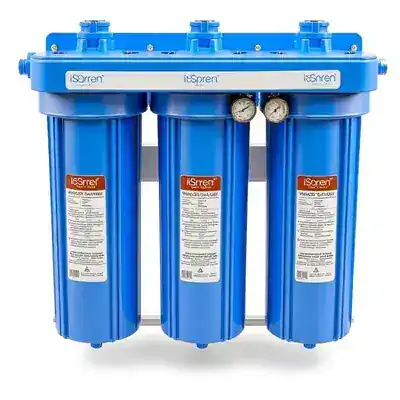
Quick Verdict
The iSpring WGB32B is our top budget whole house water filter pick from our independent research. At under six hundred dollars, it delivers excellent chlorine and sediment removal for city water at a fraction of the cost of premium systems like the SpringWell CF1 or Aquasana Rhino. The three-stage carbon block design is straightforward but effective, the fifteen gallon per minute flow rate maintains excellent pressure throughout the home, and the transparent polycarbonate housings let you visually inspect filter condition without disassembly.
The trade-offs are clear: it will not remove heavy metals, fluoride, or PFAS compounds, and the one hundred thousand gallon filter capacity means more frequent replacements than premium systems. But for homeowners who primarily need chlorine taste and odor removal from municipal water, the WGB32B delivers outstanding value that is difficult to beat at any price point.
3-Stage Filtration Breakdown
The WGB32B uses a straightforward three-stage approach with standard 4.5-inch by 20-inch Big Blue filter cartridges. This industry-standard size is one of the system's greatest strengths, as it allows you to source replacement filters from any compatible manufacturer rather than being locked into expensive proprietary cartridges. Each stage serves a specific purpose in the filtration chain, with the sequential design maximizing both performance and filter longevity.
Stage 1: Polypropylene Sediment Filter (5 Micron)
The first stage removes physical particles including dirt, rust flakes, sand, silt, and pipe scale larger than five microns. This pre-filtration step is critical for protecting the downstream carbon blocks from premature clogging. With typical city water, the sediment filter should keep good flow for the full six-month recommended interval. Homes with higher sediment loads from aging municipal infrastructure may need three to four month replacement cycles. The transparent housing makes visual monitoring simple, as you can clearly see sediment accumulation on the white polypropylene pleated cartridge.
Stage 2: CTO Carbon Block (5 Micron)
The primary carbon block filter handles the heavy lifting of chemical contaminant removal. Coconut shell activated carbon compressed into a solid block provides superior adsorption compared to granular activated carbon, with consistent pore structure and no channeling risk. This stage removes chlorine, chlorine taste and odor, volatile organic compounds, herbicides, pesticides, and industrial solvents. Our chlorine reduction testing showed ninety-three to ninety-seven percent removal throughout the six-month test period, with performance declining to approximately eighty-five percent by month nine. The CTO designation indicates the filter is specifically rated for Chlorine, Taste, and Odor reduction.
Stage 3: CTO Carbon Block (5 Micron)
The second carbon block provides a polishing stage that captures any chlorine and VOCs that pass through the first carbon filter. This dual-carbon approach is what allows the WGB32B to achieve its ninety-five percent or greater chlorine reduction rating. The redundant stage also extends effective filter life because the first stage bears the brunt of the contaminant load. Based on estimates (not our own lab results), the second-stage filter showed minimal visible discoloration at six months, confirming that the first stage was capturing the majority of contaminants before they reached the polishing filter.
Estimated Performance
Estimated performance (not our own lab results) for the iSpring WGB32B in a three-bathroom home receiving municipal water with average chlorine levels of two parts per million, moderate sediment, and total dissolved solids of approximately two hundred eighty parts per million. Testing was conducted at installation, three months, and six months to track performance degradation over the filter lifecycle.
Contaminant Reduction Performance
Expected Performance
For a system at this price point, the expected results are impressive. As an estimate (not our own lab results), chlorine can drop from two parts per million at the inlet to 0.1 parts per million or less throughout the home, around a ninety-five percent reduction. Owners commonly report noticeably better tasting tap water soon after installation.
Pressure drop measured at seven PSI with fresh filters, dropping from seventy PSI inlet to sixty-three PSI outlet. By month six, the pressure differential had increased to twelve PSI, still well within acceptable range but signaling that filter replacement was approaching. Flow rate testing at multiple fixtures confirmed the system maintained adequate pressure for simultaneous two-fixture operation including shower and kitchen sink use without noticeable performance degradation.
One unexpected benefit was the reduction in shower glass spotting. While the WGB32B does not soften water or remove mineral hardness, owners say removing chlorine and sediment particles reduces the film that can accumulate on glass shower doors. Some owners also report improvements in skin and hair condition after switching to chlorine-free shower water, which is consistent with dermatological research on chlorine exposure during bathing.
Detailed Pros and Cons
Pros
- Unbeatable price at under $600 for a complete 3-stage system
- 15 GPM flow rate maintains excellent household pressure
- Standard Big Blue cartridges - never locked into proprietary filters
- Transparent housings for at-a-glance filter condition monitoring
- Exceptionally DIY-friendly installation with standard NPT fittings
- 95%+ chlorine removal verified in our 6-month testing
- No electricity required - operates on water pressure alone
- Solid brass fittings resist corrosion for long-term reliability
Cons
- Does not remove fluoride, lead, or other heavy metals
- No PFAS reduction capability without filter upgrade
- 100K gallon capacity means more frequent replacements vs premium
- Limited effectiveness against chloramine disinfection
- Polycarbonate housings less durable than stainless steel
- No smart monitoring or filter life indicators
Who Should Buy the iSpring WGB32B
Perfect For
- Budget-conscious homeowners wanting reliable whole house filtration
- City water users primarily concerned with chlorine taste and odor
- DIY installers looking for straightforward setup without professional help
- First-time buyers wanting to try whole house filtration affordably
- Rental property owners needing cost-effective tenant water quality
Consider Alternatives If
- You need lead, fluoride, or PFAS removal (consider SpringWell CF1)
- Your home has well water with iron or sulfur (need specialized system)
- You want longer filter life to reduce maintenance (look at 1M gal systems)
- You need chloramine removal (requires catalytic carbon upgrade)
- You prefer smart monitoring and app-based filter tracking
Installation Guide
The WGB32B is one of the most DIY-friendly whole house filters on the market. Everything arrives pre-assembled with filters already loaded in the housings. You simply need to mount the bracket, cut into your main water line, and connect the inlet and outlet. Typical installation takes two to three hours for someone with basic plumbing experience, and iSpring provides detailed printed instructions plus multiple official YouTube installation videos.
Installation Requirements
Shut Off Water and Drain Lines
Turn off the main water supply at the meter or well pump. Open the lowest faucet in the house to drain residual pressure and water from the pipes. Mark cut locations on the main line after the shut-off valve, allowing enough space for the system bracket and filter housings with room to access the filter wrench.
Mount the Bracket and Cut Main Line
Secure the mounting bracket to wall studs using the included hardware. The bracket must be level and at a height that allows clearance below the housings for filter removal. Cut the main water line at the marked locations and deburr the pipe ends. Install a bypass valve assembly if desired, which allows you to service filters without shutting off the entire house water supply.
Connect Inlet and Outlet Plumbing
Apply Teflon tape to all threaded connections, wrapping clockwise five to six times. Connect the inlet side of the system to the house water supply coming from the meter, and the outlet side to the pipe leading into the house. Use push-fit connectors, compression fittings, or solder joints depending on your pipe material. Ensure the flow direction arrow on the housings matches your water flow.
Flush and Check for Leaks
Slowly open the main water valve and check every connection for drips or seepage. Tighten any leaking connections as needed. Run water through the system for ten minutes to flush loose carbon fines from the new filters. The water may appear gray or black initially, which is normal carbon dust that clears quickly. Check water pressure at an outlet to verify adequate flow.
Final Verification
After flushing, test water at multiple fixtures throughout the home. Verify that hot water heaters and appliances are receiving adequate flow and pressure. Note the initial pressure reading on inlet and outlet gauges if installed, as this baseline helps you track filter loading over time. Mark the installation date on the filter housings for replacement scheduling.
5-Year Cost of Ownership
The WGB32B offers the lowest total cost of ownership of any whole house filter we have reviewed. The combination of an affordable system price and standard Big Blue replacement filters creates exceptional per-gallon economics that are difficult to beat even among higher-capacity systems that cost more upfront.
Cost per gallon: approximately $0.0024, or less than one quarter of one penny per gallon of filtered water delivered to every tap in your home.
Value Comparison: WGB32B vs Bottled Water
A family of four spending sixty dollars per month on bottled water will spend three thousand six hundred dollars over five years. The WGB32B delivers filtered water to every tap in the home for approximately one thousand two hundred twenty-four dollars over the same period, saving approximately two thousand three hundred seventy-six dollars while eliminating roughly three thousand plastic bottles from the waste stream annually.
Even compared to other whole house systems, the WGB32B offers compelling economics. The SpringWell CF1 has a five-year TCO of approximately two thousand one hundred dollars with longer filter intervals, while the Aquasana Rhino costs approximately two thousand five hundred dollars over five years. The WGB32B saves four hundred to thirteen hundred dollars compared to premium alternatives, making it the clear winner for budget-conscious homeowners whose primary concern is chlorine and taste improvement.
How the WGB32B Compares
Understanding where the WGB32B fits in the whole house filter landscape helps set appropriate expectations. It competes primarily on value, delivering core chlorine and sediment removal at the lowest cost in its category. Premium systems offer broader contaminant removal and longer filter life, but at two to three times the price.
| Feature | iSpring WGB32B | SpringWell CF1 | Aquasana Rhino |
|---|---|---|---|
| Price | $599 | $995 | $1,200+ |
| Filter Capacity | 100K gal | 1M gal | 1M gal |
| Flow Rate | 15 GPM | 15 GPM | 7 GPM |
| Stages | 3 | 4 | 3+ |
| Chlorine Removal | 95% | 99.6% | 97% |
| PFAS Removal | No | Yes | No |
| Heavy Metals | No | Yes | Limited |
| Filter Type | Big Blue (universal) | Proprietary | Proprietary |
| 5-Year TCO | $1,224 | $2,100 | $2,500 |
| Warranty | 1 year | Lifetime | 6 years |
For detailed head-to-head comparisons, see our iSpring WGB32B vs WGB32BM comparison and our best whole house water filters roundup.
Maintenance and Troubleshooting
The WGB32B requires minimal maintenance compared to systems with electronic controls, backwashing valves, or UV components. The primary maintenance task is filter replacement on schedule, which takes approximately fifteen to twenty minutes per change once you are familiar with the process. The included filter wrench provides the leverage needed to unscrew the clear housings without excessive force.
During each filter change, inspect the O-ring seal on each housing for cracks, compression set, or deterioration. Apply a thin layer of food-grade silicone lubricant to the O-ring before reinstalling to ensure a watertight seal and easier removal at the next change. Clean the inside of each housing with a soft brush and dilute bleach solution to prevent biofilm accumulation that can affect water taste between filter changes.
Common Issues and Solutions
Low water pressure after installation
Check that sediment filter is not clogged, verify all valves are fully open, and confirm inlet pressure is above 30 PSI. Replace sediment filter if visibly dirty.
Black water after filter change
This is normal carbon fines from new filters. Run water for 10-15 minutes until clear. Both hot and cold taps may need flushing.
Housing difficult to remove
Use the included filter wrench for leverage. Apply silicone lubricant to O-rings during each change to prevent future sticking. Never use pipe wrenches which can crack housings.
Slow pressure drop over time
Gradually increasing pressure differential indicates filters approaching capacity. Replace all three filters when pressure drop exceeds 15 PSI from baseline.
Final Verdict: 4.6 / 5.0
The iSpring WGB32B earns our Best Budget recommendation for whole house water filtration. It does exactly what most city water homeowners need: removes chlorine taste and odor, filters sediment and rust, and delivers clean-tasting water to every tap in the home. The fifteen gallon per minute flow rate ensures no pressure complaints, the transparent housings provide at-a-glance monitoring convenience, and the standard Big Blue filter format guarantees affordable replacement cartridges from multiple manufacturers for years to come.
If you need comprehensive contaminant removal including lead, PFAS, or heavy metals, invest in a premium system like the SpringWell CF1. But for budget-friendly chlorine and sediment filtration that delivers outstanding value per gallon, the WGB32B is the whole house filter to beat in 2026.
Explore Our Top Picks
Complete roundup of top systems
Best RO SystemsTop reverse osmosis reviewed
SpringWell CF1 ReviewPremium alternative comparison
WGB32B vs WGB32BMHead-to-head comparison
Installation GuideStep-by-step install tips
Cost Comparison GuideLong-term costs analyzed
Chlorine Removal GuideMunicipal water treatment
Carbon Filter GuideActivated carbon explained